Sei du selbst. Alle anderen sind bereits vergeben.
— Oscar Wilde
Dies ist der erste Beitrag in meinem neuen Blog. Ich beginne gerade erst mit dem Bloggen; bleibt also dran, es folgen bald weitere Beiträge. Melde dich unten an, um eine Benachrichtigung zu erhalten, wenn ich etwas Neues poste
It is now 11 weeks since my participation at BEMM129, and it is time for me to reflect on a module which was like none of my modules before. When I started the module, I expected that it would be designed and assessed like other modules and that I would learn a lot about digital business models and future opportunities. Even though the new way of teaching online and the assessment in the form of a blog initially confused and frightened me, as there were many websites and different channels to get used to in the beginning, in retrospect I am really enthusiastic about the module structure.
A central part of the module was online interaction and communication with others on specific topics and issues. Notably, the online course Futurelearn.com encouraged this. The topics were really interesting, well-structured and therefore easy to follow. If something was particularly interesting, one could do a little more research and start a conversation about it in the comments. Thus, a very interesting discussion developed, which enriched all by a multiplicity of different views and aspects. I really enjoyed participating in these discussions. It broadened my horizon and I was able to develop new ideas based on the objections of my peers. Therefore, in addition to my digital skills, by creating my own blog and using various features that were new to me such as videos and gifts and the imparted knowledge from the content of the course, I was able to expand my online communication skills and learn to overcome my shyness.
Furthermore, the module changed my view and has helped me not to just condone everything but to question certain things. For example, I have always assumed things I have read on the Internet are correct and have never really questioned references. Also, I considered everything concerning digital and technological development as positive. I was not aware of risks and adverse side effects such as possible job losses and the consequences of fake news, echo chambers, filter bubbles and algorithms.
All in all, since the Internet is nowadays a central part of our daily life, I could take a lot out of this module, and I see many things differently now. I am convinced it has provided me with the knowledge that prepares me well for my digital future and has taught me how to interact with the Internet in the best possible way to make the most of it.
In times of digitalisation, the rise of the internet and mobile devices, there is almost everything available to shop online (Dentzel, 2013). However, products such as eyeglasses have for a long time only been available offline, or at least people thought that they had to buy glasses offline because they require professional knowledge and have to be customized. The company Mister Spex (MS) was one of the first to break through the traditional business model of the optician industry. It launched in 2007 a successful digital business model via its online shop (Ecommerce News, 2018). In the following blog post, I want to examine the digital business model of MS and work out how and why it has contributed to its great success.
To do so, I firstly want to introduce the company MS to you. Since its foundation, it has become one of the leading online opticians in Europe (Mister Spex GmbH a, 2020). Nowadays, it has over 3 million customers, is operating in 10 European countries, has partnerships with over 500 local opticians and has opened 11 own retail stores. In 2016 the company received the Red Dot Award for its innovative shop concept (DN Capital, 2019). But what is it that makes MS’s store concept so innovative and its business model so successful?
To begin with, the focus of its business model is on creating added value for its customers compared to its competitors. Although it started as an online shop, it soon cooperated with many local opticians and evolved into a multi-channel system to offer its customers various distribution options. The partnerships and the opening of its own shops had many advantages for the company and are very decisive for its success. Firstly, it helped MS to generate new local customers who were previously unfamiliar with the brand. Secondly, it has enabled the company to help inexperienced customers to switch to online shopping. Once they have completed an eye test, which is included in the purchase, and the correct lenses have been identified, the customer can create an account online. From then on, the customer can have any type of glasses or frames made online according to his individual needs and have them delivered to his home. Additionally, local partnerships and own retail stores enable MS to provide exceptional customer service, which creates a tremendous competitive advantage. The partners also benefits from it and receive a certain margin on each purchase (Mister Spex GmbH, 2020; Sven, 2016).
Furthermore, MS stands for high quality, cost transparency and a wide product portfolio. Due to its online presence, reputation and high awareness through marketing campaigns and local optician partners, it could straightforwardly enter foreign markets in Europe and broaden its product portfolio. Nowadays, the company has the largest product range in the European market. This is only possible because of its digital business models, which includes great technological and digital support in terms of operating processes, logistic and shipment. Its website provides simple handling of purchases and offers various payment opportunities, including free shipment (Mister Spex GmbH a, 2020). Its digital business model connects its offline and online performances, runs various touchpoints to interact with its customers and organises all logistics operations. Its ‚Intershop Commerce Management‘ forms a robust platform for all visitors and offers a customized and user-friendly experience across all channels (Intershop Communications AG, 2020).
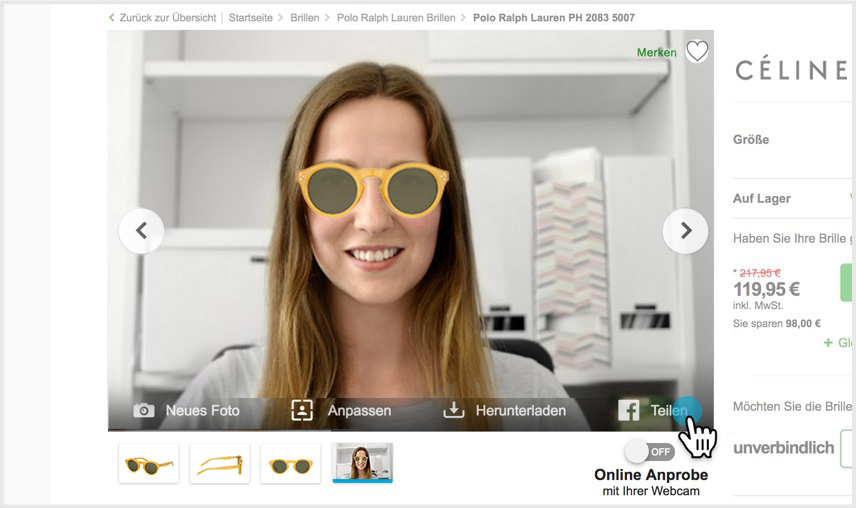
A just recently added feature of MS which adds a lot of value to its business model is the integration of virtual reality (VR) tool to its website. It enables customers to try on glasses and sunglasses online by uploading a picture of themselves or recording live with a camera and see directly how the product suits them. Being able to try the product online reduces the risk of making a bad buy and encourages people to buy online as there is no need to go to a local store for a fitting (Mister Spex GmbH c., 2020). The implementation of VR in its business model shows how innovative the company is. There are forecasts that virtual reality with other enhanced technologies will have a significant impact on the retail industry and change its business environment in the future (Martínez-Navarro, Bigné, Guixeres, Alcañiz, & Torrecilla, 2019). The following chart gives an idea of the potential economic impact in the retail industry due to VR for the future (ABI Research; Statista estimates, 2019).
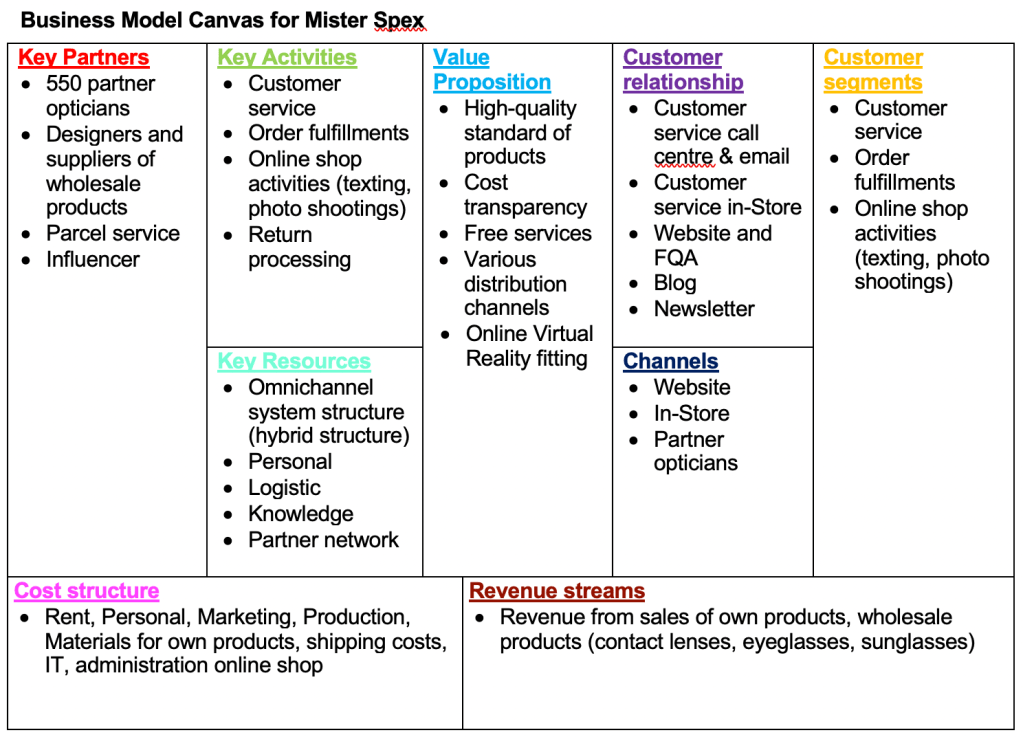
In conclusion, the hybrid store concept and the well-functioning connection of online and offline is what makes MS so successful. Additionally, it can be assumed that this in combination with its convenient handling, excellent customer support and its good reputation has encouraged people to loose the fear to buy their glasses online. The implementation of VR gives the company an additional competitive advantage. It enables its customers to try on their glasses online, which takes away the fear of making the wrong purchases. In order to summarize its digital business model and to make it clearer, I have used the framework of the business model in Appendix 1 (Osterwalder & Pigneur, 2010). What do you think of this digital business model and could you imagine buying your glasses online?
Appendix 1: Business Model MS (Mister Spex GmbH a, 2020).
Martínez-Navarro, J., Bigné, E., Guixeres, J., Alcañiz, M., & Torrecilla, C. (2019). The influence of virtual reality in e-commerce. Journal of Business Research.
There is no doubt that digital and technical developments have changed our lives in various ways. Not only personal and private interactions, such as the way we communicate and connect with others through social media platforms, but also the business environment of many industries and the way to do business. Advanced technologies and the rise of the internet create for our society multiple new opportunities and challenges (UNCTAD, 2019).
The advent of a digital economy has enabled new business models and changed the way companies do business, and thus the role of many employees and managers (Barefoot, Curtis, Jolliff, Nicholson, & Omohundro, 2018). As a result, many people fear to lose their jobs due to the development of robots or automatisms through new advances in digitalisation and technology (PwC, 2019). However, the impacts of the digital economy are diverse and far-reaching as it overlaps with certain factors and circumstances. This makes it difficult to measure and classify its implications (Brynjolfsson, 1993). Nevertheless, the following blog post aims to evaluate how the job of a salesperson changed in the digital economy and is likely to change in the future, focusing on the apparel industry.
Over the last twenty years, the business environment of the apparel industry has changed significantly. In particular, the establishment of the Internet around 1960 and further technological advances that enabled the development of e-commerce platforms, in the early 1990s, greatly influenced the industry. The emergence of e-commerce, which simplified describes a ‘business transaction through communication technology’ enables consumers to shop and inform themselves about product independently of time and place. This had a significant effect on consumer behavior and demand (Singh A. , 2019, p. 30).
Nowadays, e-commences are for most apparel companies an integral part of their business model and crucial for success (World Economic Forum, 2017). As a result, the consumer buying process changed and many local retail stores adapted and created global virtual businesses in form of online stores (Hagberg, Sundström, & Egels-Zandén, 2016). This created the concept of omnichannels for apparel businesses which enables companies to interact with its customers in various ways offline as well as online with the aim to establish stronger customer relationships (Verhoef, Kannan, & Inman, 2015).
These developments and changes consequently also affected the work of retail salespersons. Customers have become more demanding and powerful, due to the many new shopping and information possibilities, created by digitalisation and the Internet. While earlier the job of a salesperson was to inform and persuade customers of goods, who had limited numbers of sales channels, nowadays it involves much more qualities. Salespersons are required to build a strong customer relationship, act as consultants and add value for the customer to create a maximum in-shop experience that cannot be offered online. This includes being an expert not only of the products you offer but also about the industry as a whole, having knowledge of competitors and current trends (Dooley, 2019).
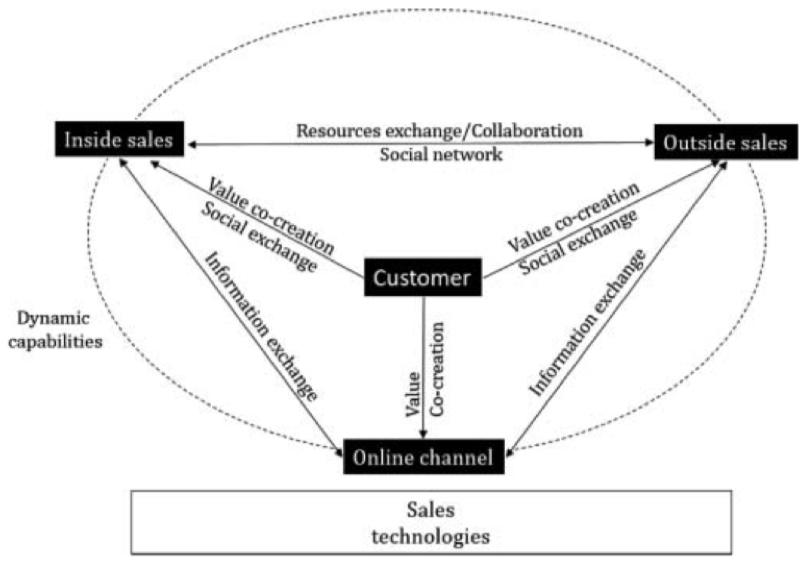
Furthermore, digital and technological developments have an impact on the structure and organisation of the sales force. The establishment of e-commerce in the form of online shops in combination with local retail stores requires so-called outside and inside salespersons. This created the need for a hybrid personnel structure for companies in order to enable all-round interaction with the customer and internal information exchange (Singh, et al., 2019, p. 8).
Besides, higher technological skills are required of the salespersons. Today’s salespersons are confronted with more technological processes and systems that they need to be able to use properly for their daily working life. This can be, for example, electronic data storage of costumers and products information, electronic payment methods, cash systems as well as logistic processes of goods. Technological and digital innovations should support the sales force and enable them to work more efficiently and effectively (Thaichon, Surachartkumtonku, Quach, Weaven, & Palmatier, 2018).
What the future might hold for the job of retail salespersons is difficult to forecast. On the one hand, there are voices, which claim that developments and improvements in technology will replace salespersons by electronic systems. This would mean salespersons would lose their bargain power and lead to job losses. On the other hand, there are opinions that salespersons will be further supported by technological improvements and processes to make their work even more efficient and effective, but that human salespersons will always be necessary and required to build up strong customer relationships (Singh, et al., 2019).
Personally, I believe that technology can support the work of a salesperson and create added value for them by making their job easier. The added value can lead to a higher efficiency and effectiveness of the individual, but also to the fact that fewer sales staff are needed. Nevertheless, I am convinced that technology and digital innovation will never be able to replace a human sales force completely. A salesperson will always be required because technology will never be able to build up the same customer relationship as people with each other.
Hagberg, J., Sundström, M., & Egels-Zandén, N. (2016). The digitalization of retailing: an exploratory framework. International Journal of Retail & Distribution Management, 44.
Singh, A. (2019). Changing Scenario of Business and E-Commerce : Trends and Issues. Society Publishing.
Singh, J., Flaherty, K., Sohi, R., Deeter-Schmelz, D., Habel, J., Meunier-FitzHugh, K., . . . Onyemah, V. (2019). Sales profession and professionals in the age of digitization and artificial intelligence technologies: concepts, priorities, and questions. Journal of Personal Selling & Sales Management.
Thaichon, P., Surachartkumtonku, J., Quach, M., Weaven, S., & Palmatier, R. (2018). Hybrid sales structures in the age of e-commerce. Journal of Personal Selling & Sales Management, 38(3), 277–302.
UNCTAD. (2019). Digital Economy Report 2019: Value creation and capture: Implications for developing countries. United Nations Publications.
Verhoef, P. C., Kannan, P. K., & Inman, J. J. (2015). From Multi-Channel Retailing to Omni-Channel Retailing: Introduction to the Special Issue on Multi-Channel Retailing. Journal Retailing, 91(2), 174-181.
World Economic Forum. (2017). Shaping the Future of Retail for Consumer Industries. World Economic Forum.
Hi, I am Selina Winter and I am studying International Management. I am from Hamburg (Germany) as you can see on my blogpost cover picture. I studied for my undergraduate fashion management in Berlin. There is no doubt that the digital business world is constantly growing and becoming more and more crucial for every industry. Advanced technology, digitalisation and the related rise of the internet changed the way to communicate and doing business in many industries.
I first experienced the importance of digital business models during my Bachelor’s degree, because e-commerce in particular is an integral and decisive part of the fashion industry today. Additionally, there a various companies and new business models which could only establish and grow due to this development such as online shops or the concept of the sharing economy. I believe that digital business models will become more and more important and decisive for the success of companies and organisation. Furthermore, I am curious and very interested in the development of the digital economy and the potential of digital business models for organisations, so I would like to explore this area further
Dies ist ein Beispielbeitrag, ursprünglich veröffentlicht im Rahmen der Blogging University. Nimm an einem unserer zehn Programme teil und starte noch heute mit deinem Blog.
Du wirst heute einen Beitrag veröffentlichen. Mach dir keine Gedanken darüber, wie dein Blog aussieht. Es ist egal, ob du ihm bereits einen Namen gegeben hast oder nicht. Fühl dich nicht überfordert. Klicke einfach nur auf den Button „Neuer Beitrag“ und erzähle uns, warum du hier bist.
Warum tun wir das?
Weil neue Leser so mehr Informationen erhalten. Wer bist du? Worum geht es bei dir? Warum sollten sie dein Blog lesen?
Weil dies dir helfen wird, dich auf deine eigenen Ideen zu konzentrieren und darauf, was du mit deinem Blog erreichen möchtest.
Der Beitrag kann lang oder kurz sein, eine persönliche Einführung zu deinem Leben oder eine Botschaft enthalten, ein Manifest für die Zukunft werden oder einfach kurz darstellen, welche Dinge du zukünftig veröffentlichen möchtest.
Damit du beginnen kannst, haben wir hier einige Fragen an dich.
Warum führst du ein öffentliches Blog und kein persönliches Tagebuch?
Über welche Themen möchtest du schreiben?
Mit wem möchtest du über dein Blog in Kontakt kommen?
Wenn dein Blog im kommenden Jahr erfolgreich ist: Was möchtest du erreichen?
Dies sind keine starren Fragen. Das Schöne an einem Blog ist, dass er sich ständig entwickelt, je nachdem, was wir lernen oder wem wir begegnen. Es ist jedoch gut zu wissen, wo und warum du dieses Blog begonnen hast. Und darüber hinaus kannst du durch die Formulierung deiner Ziele weitere Inspirationen erhalten.
Du weißt nicht, wie du beginnen sollst? Schreibe einfach auf, was dir gerade in den Kopf kommt. Anne Lamott, Autorin eines tollen Buchs zum Thema Schreiben, sagt, dass du dir selbst die Erlaubnis geben musst, einen „ersten schlechten Entwurf“ zu verfassen. Anne spricht einen wichtigen Punkt an: Beginne einfach mit dem Schreiben und bearbeite deinen Entwurf erst später.
Wenn du bereit bist, deinen Beitrag zu veröffentlichen, füge ihm drei bis fünf Schlagwörter hinzu, die das Thema deines Blogs erfassen: Schreiben, Fotografie, Fiction, Erziehung, Essen, Autos, Filme, Sport usw. Mithilfe dieser Schlagwörter können Leser, die sich für deine Themen interessieren, deinen Beitrag schneller im Reader finden. Vergewissere dich, dass eines der Schlagwörter „zerotohero“ ist, sodass dich auch neue Blogger finden können.