
There is no doubt that digital and technical developments have changed our lives in various ways. Not only personal and private interactions, such as the way we communicate and connect with others through social media platforms, but also the business environment of many industries and the way to do business. Advanced technologies and the rise of the internet create for our society multiple new opportunities and challenges (UNCTAD, 2019).
The advent of a digital economy has enabled new business models and changed the way companies do business, and thus the role of many employees and managers (Barefoot, Curtis, Jolliff, Nicholson, & Omohundro, 2018). As a result, many people fear to lose their jobs due to the development of robots or automatisms through new advances in digitalisation and technology (PwC, 2019). However, the impacts of the digital economy are diverse and far-reaching as it overlaps with certain factors and circumstances. This makes it difficult to measure and classify its implications (Brynjolfsson, 1993). Nevertheless, the following blog post aims to evaluate how the job of a salesperson changed in the digital economy and is likely to change in the future, focusing on the apparel industry.
Over the last twenty years, the business environment of the apparel industry has changed significantly. In particular, the establishment of the Internet around 1960 and further technological advances that enabled the development of e-commerce platforms, in the early 1990s, greatly influenced the industry. The emergence of e-commerce, which simplified describes a ‘business transaction through communication technology’ enables consumers to shop and inform themselves about product independently of time and place. This had a significant effect on consumer behavior and demand (Singh A. , 2019, p. 30).
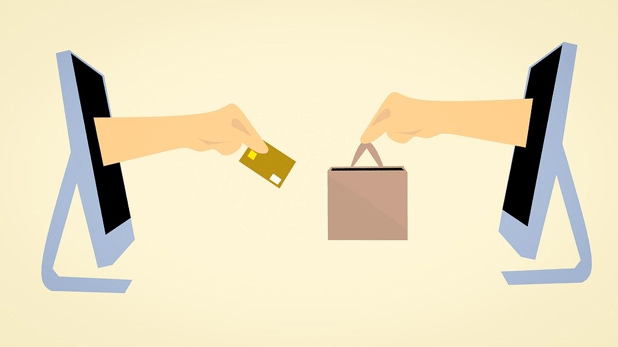
Nowadays, e-commences are for most apparel companies an integral part of their business model and crucial for success (World Economic Forum, 2017). As a result, the consumer buying process changed and many local retail stores adapted and created global virtual businesses in form of online stores (Hagberg, Sundström, & Egels-Zandén, 2016). This created the concept of omnichannels for apparel businesses which enables companies to interact with its customers in various ways offline as well as online with the aim to establish stronger customer relationships (Verhoef, Kannan, & Inman, 2015).
These developments and changes consequently also affected the work of retail salespersons. Customers have become more demanding and powerful, due to the many new shopping and information possibilities, created by digitalisation and the Internet. While earlier the job of a salesperson was to inform and persuade customers of goods, who had limited numbers of sales channels, nowadays it involves much more qualities. Salespersons are required to build a strong customer relationship, act as consultants and add value for the customer to create a maximum in-shop experience that cannot be offered online. This includes being an expert not only of the products you offer but also about the industry as a whole, having knowledge of competitors and current trends (Dooley, 2019).
Furthermore, digital and technological developments have an impact on the structure and organisation of the sales force. The establishment of e-commerce in the form of online shops in combination with local retail stores requires so-called outside and inside salespersons. This created the need for a hybrid personnel structure for companies in order to enable all-round interaction with the customer and internal information exchange (Singh, et al., 2019, p. 8).
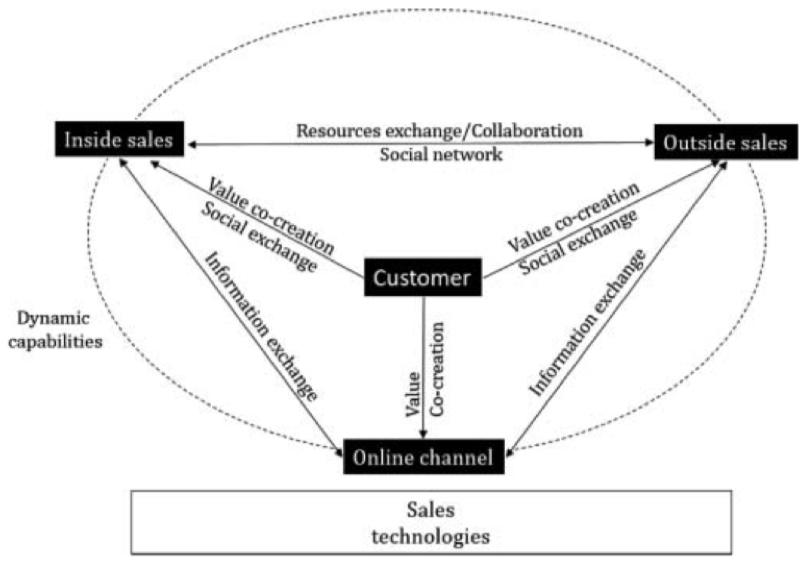
Besides, higher technological skills are required of the salespersons. Today’s salespersons are confronted with more technological processes and systems that they need to be able to use properly for their daily working life. This can be, for example, electronic data storage of costumers and products information, electronic payment methods, cash systems as well as logistic processes of goods. Technological and digital innovations should support the sales force and enable them to work more efficiently and effectively (Thaichon, Surachartkumtonku, Quach, Weaven, & Palmatier, 2018).
What the future might hold for the job of retail salespersons is difficult to forecast. On the one hand, there are voices, which claim that developments and improvements in technology will replace salespersons by electronic systems. This would mean salespersons would lose their bargain power and lead to job losses. On the other hand, there are opinions that salespersons will be further supported by technological improvements and processes to make their work even more efficient and effective, but that human salespersons will always be necessary and required to build up strong customer relationships (Singh, et al., 2019).
Personally, I believe that technology can support the work of a salesperson and create added value for them by making their job easier. The added value can lead to a higher efficiency and effectiveness of the individual, but also to the fact that fewer sales staff are needed. Nevertheless, I am convinced that technology and digital innovation will never be able to replace a human sales force completely. A salesperson will always be required because technology will never be able to build up the same customer relationship as people with each other.
Reference list
Barefoot, K., Curtis, D., Jolliff, W., Nicholson, J. R., & Omohundro, R. (2018). Defining and Measuring the Digital Economy. Retrieved January 2020, from https://www.bea.gov/sites/default/files/papers/defining-and-measuring-the-digital-economy.pdf
Brynjolfsson, E. (1993). The productivity paradox of information technology. Communications of the ACM, 36(12), 66-77.
Dooley, K. (2019). Resourceful Selling. Retrieved January 2020, from The changing and evolving role of the salesperson: https://www.resourcefulselling.com/evolving-role/
Hagberg, J., Sundström, M., & Egels-Zandén, N. (2016). The digitalization of retailing: an exploratory framework. International Journal of Retail & Distribution Management, 44.
Maxpixels.com. (n.d.). Online E Commerce. Retrieved January 2020, from https://www.maxpixels.net/static/photo/1x/Selling-OnlineEcommerce-Online-Sales-E-Commerce-3021581.jpg
PwC. (2019). PwC. Retrieved January 2020, from PwC publishes results of global survey on technology, jobs and skills: https://www.pwc.com/gx/en/news-room/press-releases/2019/global-skills-survey-2019.html
Singh, A. (2019). Changing Scenario of Business and E-Commerce : Trends and Issues. Society Publishing.
Singh, J., Flaherty, K., Sohi, R., Deeter-Schmelz, D., Habel, J., Meunier-FitzHugh, K., . . . Onyemah, V. (2019). Sales profession and professionals in the age of digitization and artificial intelligence technologies: concepts, priorities, and questions. Journal of Personal Selling & Sales Management.
Thaichon, P., Surachartkumtonku, J., Quach, M., Weaven, S., & Palmatier, R. (2018). Hybrid sales structures in the age of e-commerce. Journal of Personal Selling & Sales Management, 38(3), 277–302.
UNCTAD. (2019). Digital Economy Report 2019: Value creation and capture: Implications for developing countries. United Nations Publications.
Verhoef, P. C., Kannan, P. K., & Inman, J. J. (2015). From Multi-Channel Retailing to Omni-Channel Retailing: Introduction to the Special Issue on Multi-Channel Retailing. Journal Retailing, 91(2), 174-181.
World Economic Forum. (2017). Shaping the Future of Retail for Consumer Industries. World Economic Forum.
 sw790
sw790 

The changing retail experience in fashion stores as a result of technologies has been evident from a number of brands that are using different technologies to try and differentiate from competitors. I agree with your point that technologies are likely to support the work of the salesperson although I do not know if I agree that it would make their job “easier”. I think the integration of technologies would raise the sophistication of the shoppers, making them more demanding and knowledgeable about products, and making it more essential for salespeople to have a better focus on one-to-one selling. This is especially the case in premium and luxury sectors.
LikeLike
As you have mentioned, digitalisation has not only changed consumer behaviour and demand but also the work of retail salespersons. I agree with you that technology can support a salesperson’s job. Through optimized processes and added value, the work becomes more efficient and effective. Furthermore, I also think that the human skills to build strong customer relationships and gain their loyalty cannot be replaced by a robot. Hence, in contrast to the opinion that technology will lead to job losses in the retail industry, I personally think that the future will see a growing importance of a salesperson’s soft skills in physical stores while new jobs are created through the increasing importance of e-commerce in form of online salespersons.
LikeLike
Hi!
Having worked as a salesperson for a summer job, I really witnessed the impact of digitalization on that particular position. I had for example a smartphone with a dedicated app to check product availability in other stores and online, or to restock products. As a result I would agree in saying that salespersons not only have to know their products today, but also have to understand more broadly the customer’s journey and the channels he or she uses to gather information and purchase.
I think as well that salespersons will not disappear in the future, even if they might need to be more trained and to possess digital skills. Particularly in the higher end segment of the apparel industry, I believe that customers will keep asking for a high-quality personalized experience, that only human interaction can provide.
LikeLike
Hello everyone,
Thank you for your insightful post on the impact of digital business on sales jobs. People must start educating themselves in the digital world to gain an advantage in the market. Salespeople that currently engage with customers online through different channels gain an edge over the salespeople that do not communicate well.
Ever since selling products is one of the oldest „jobs“ from when people were selling products at markets, but now people are selling products at online markets, and communication is still the most critical part of sales. In the present, technology helps people that work in sales by saving them time and caring information about products or services. If you walk into a shoe store and you ask any staff member if they have the right shoe size, they will grab their phone and scan your selected product and immediately tell you that they have it and if not they can order it and you can pick it up the next day or it will be shipped to your house.
With the right technology and communication, a business can gain higher retention rates and increase sales.
LikeLike